Showing posts with label Trading and Investing. Show all posts

Low-Risk Stocks Outperform High-Risk Stocks

. July 10, 2014

Have you heard the saying, "Low risk, low return?" Stocks that go up and down less than the market have low risk (low beta) and should offer lower returns than high-beta stocks. This is the common-sense relationship between risk and return predicted by the capital asset pricing model (CAPM), which most professionals would use to manage your money.

The truth may surprise you.

Real-world data contradict CAPM's predictions. A paper titled Country and Sector Drive Low-Volatility Investing in Global Equity Markets finds that a portfolio of low-risk stocks formed from the cap-weighted MSCI World Index has a return that is higher than that of the index itself.

From 1978 to 1996, the low-risk portfolio had a return of 18.5% (Sharpe ratio 0.98), while the index had a return of only 15.0% (Sharpe ratio 0.56). From 1997 to 2012, the low-risk portfolio had a return of 9.6% (Sharpe ratio 0.74), while the index had a return of only 5.5% (Sharpe ratio 0.17).

It's worth pointing out that it's easy to beat the cap-weighted index, despite what some experts say. Even picking stocks randomly will do it. But one of the few things worse than a cap-weighted index is a portfolio made up of high-risk, high-beta stocks. (See Equal-Weight Benchmarking, p. 3.)

The chart below, taken from the paper, explains why the low-risk strategy works.
Beta and Up/Down Capture by Min Vol Strategy
The low-risk portfolio, represented by the tan bars in the chart, has a beta of 51%, meaning that when the index goes up or down, it should move 51% as much as the index does. "Low risk, low return," right?

But the chart shows that this isn't actually what happens. When the index goes up, the low-risk portfolio goes up more than its beta says it should, as reflected in the upside capture of 64%. The return is 1.25 times what it's "supposed" to be.

When the index goes down, the low-risk portfolio goes down less than its beta says it should, as reflected in the downside capture of 32%. The loss is only 0.63 times as large as it's "supposed" to be.

The low-risk portfolio outperforms the index over a long period of time because it outperforms its beta in both up and down markets.

(The blue bars in the chart shows that the low-risk strategy also works if you group the stocks by country and sector first and then build a portfolio based on the lowest-risk country/sector combinations. The paper describes this in more detail.)

A spate of articles has come out recently saying that low-risk portfolios haven't worked in the past few years, since their return has been lower than the market's return. To evaluate these criticisms, look at the beta of a low-risk portfolio. If its beta is 50%, it is half as risky as the market, and it should only provide half the return (assuming interest rates are near zero). If its return is higher than half of the market's return, the portfolio is doing what it's supposed to.

Low-risk stocks do better than stocks as a whole because their return is only slightly lower in bull markets and is much better than average in bear markets.

Some people use leverage, borrowing money at a low rate, to be able to buy a larger amount of a low-risk portfolio, making its beta equal to that of the index. Since the low-risk portfolio already has a higher long-term return than the index does, leverage increases that return even more.

Common Sense is Not Common True

If you need more evidence, look at the chart below, taken from a paper titled The Volatility Effect: Lower Risk Without Lower Return. The chart has a line moving upward from left to right showing a low return for low-risk (low beta) stocks. The line was drawn using predictions from CAPM.
Theoretical relation between beta and return
There's nothing in the chart that would surprise most financial professionals. The problem is that I cheated.

It's not actually the chart taken from the paper. I erased the real-world data before showing it to you.

Here's the real chart:
Empirical versus theoretical relation between beta and return
The data points don't fit the line at all. In fact, they seem to trend in the opposite direction. Low-risk, low beta portfolios have higher returns than high-risk, high beta portfolios.

A paper titled Betting Against Beta shows that low-risk assets outperform their betas for U.S. stocks, 20 international markets, the Treasury bond market, the corporate bond market, and the futures markets.

The paper hypothesizes that low-risk works because of mutual fund managers. They try to outperform the market, but they're not allowed to use leverage, so they buy high-risk stocks instead. This drives up the price of high-risk stocks, causing a drag on returns, while leaving low-risk stocks underpriced.

The authors of the paper look at actual portfolios to test their hypothesis:

We study the equity portfolios of mutual funds and individual investors, which are likely to be constrained. Consistent with the model, we find that these investors hold portfolios with average betas above 1. On the other side of the market, we find that leveraged buyout (LBO) funds acquire firms with average betas below 1 and apply leverage. Similarly, looking at the holdings of Berkshire Hathaway, we see that Warren Buffett bets against beta by buying low-beta stocks and applying leverage.
Mutual funds hold risky, high-beta stocks. Warren Buffett, on the other hand, buys low-risk, low-beta stocks and applies leverage, accessing money at favorable terms so he can buy more.

People think leverage is risky, but risk depends on what the leverage is buying. The data suggest that using leverage to buy low-risk stocks is a better idea than buying high-risk stocks without leverage. An alternative, sort of like using leverage, is to change a portfolio over to low-risk stocks and to use more of the portfolio than normal for stocks and less for bonds.

Another way to invest in low risk, discussed in a paper titled Capitalizing on the Greatest Anomaly in Finance with Mutual Funds, is to buy funds with low betas.

There are also specially-designed low-risk exchange-traded funds that can be bought and sold like individual stocks. They have favorably low expense ratios. However, retirement accounts typically have limited choices that may not include these funds.

Be Brave

What we've discussed may make financial professionals uncomfortable. The low-risk, high-return phenomenon has been known since the 1970's, but people are still taught the capital asset pricing model in school, and they still use it to manage money.

Strategies with academic research behind them, like low-risk investing, value, and momentum, get ignored in favor of passive investing. Beating the market is said to be hard, despite evidence that a cap-weighted market index like the S&P 500 historically has been beaten by picking stocks randomly.

If you challenge the capital asset pricing model, you challenge what people were taught in school. You challenge what they do for a living. You challenge their worldview.

Think different. Be brave.


Cheap Stocks Outperform Expensive Stocks

. July 2, 2014

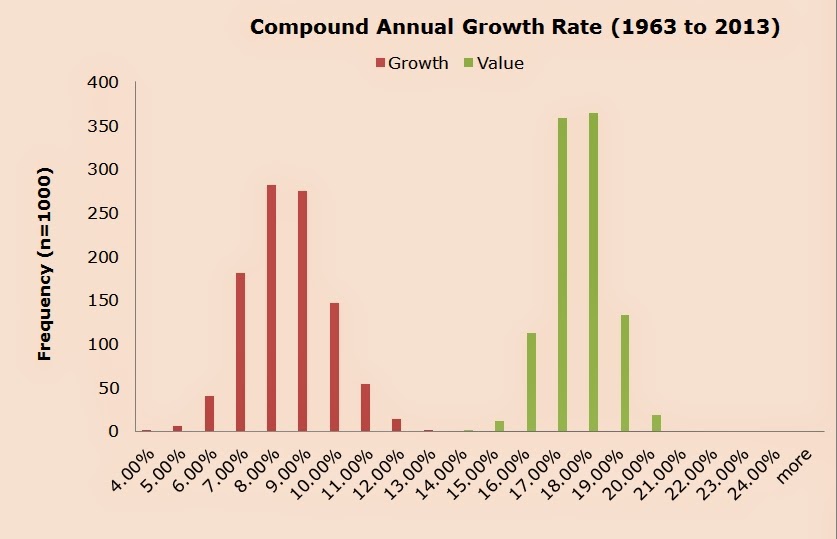
Here's a recent article testing growth ("expensive") stocks and value ("cheap") stocks. The test finds that, very consistently, value has higher returns and lower volatility risk than growth. The U.S. stock market is currently on the expensive side, and stock markets outside the U.S., especially emerging markets, are on the cheap side.

A chart taken from the article:
Growth vs. value: Compound annual growth rate

There is a lot of academic evidence suggesting that value stocks should be offered as a benchmark to follow. The evidence is so strong that most academic studies actually use value as a control.

One of the problems with cap-weighting (for example, the S&P 500 index is cap-weighted) is that cap-weighting gives more weight to stocks that have gone up in price and gotten more expensive. This is probably the reason that cap-weighting underperforms almost every other method of indexing - even an indexing method that picks stocks randomly.

Click through to read the entire article: Never Buy Expensive Stocks. Period.

One can't even simulate a scenario where a diversified portfolio of 30 expensive stocks can beat the worst performing portfolio of 30 cheap stocks. Why investors allocate to expensive, or "growth," stocks is beyond me.

Picking Stocks Randomly Beats the Market

. July 1, 2014

Is it a good thing to put your money "in the market?" That depends on what you mean. Most people will steer you toward cap-weighted funds (the S&P 500, for example, is a cap-weighted index). Research suggests that of all the ways to balance stocks in a portfolio, cap-weighting is one of the worst.

Article in plain English: Index Monkeys Beat Cap-Weighting 

Researchers have found that equity indices constructed randomly by 'monkeys' would produce higher risk-adjusted returns than an equivalent market capitalisation-weighted index over the last 40 years.

White paper: Equal-Weighted Benchmarking: Raising the Monkey Bars 
Given the disappointing performance of active managers, it is particularly surprising how many alternatively weighted indices outperformed the cap-weighted S&P 500.... A more comprehensive critique conducted by the Cass Business School showed that “...equity indices constructed randomly by 'monkeys' would have produced higher risk-adjusted returns than an equivalent market capitalization-weighted index over the last 40 years. A study based on monthly U.S. share data from 1968 to 2011 found nearly all 10 million indices weighted by chance delivered vastly superior returns.” This counterintuitive and remarkable result deserves specific emphasis. According to these results, in the period from 1969 to 2011, if you had picked stocks at random, there is a 99.9% chance you would have beaten the market.

Facebook Page on Quantitative Trading

. June 26, 2014

Over the past few years, I've gravitated toward multi-strategy thinking. What strategies tend to do well when momentum underperforms for a few years? What strategies have a low correlation with momentum that can help diversify it?

The strategies have been debated in academic papers for decades, so they're not hard to find. Integrating them into a portfolio is more of a challenge.

The obvious way to combine strategies is to use leverage: for example, to reduce the market risk of a momentum strategy as much as possible, to do the same thing with a value strategy, and then to borrow money at a low rate in order to get exposure to both. There is a risk that momentum and value will both underperform at the same time and that the leverage will end up hurting the portfolio. Now imagine managing the risk of four or eight strategies integrated in the same way.

I've chosen not to go with the obvious method, but instead to pick from a universe of exchange-traded funds using a quantitative method to select funds based on multiple strategies. The tradeoff is the increased amount of information I have to process to actually put on a trade. Most people would say that this is more trouble than it's worth.

So far, I've hesitated to post about anything other than trend-following momentum using moving averages other than on the resources page. Most people aren't obsessed with trading, and information overload might cause them to give up on it completely.

That's why I've been posting the information overload links to a Facebook page for the past three years. If you really are obsessed, check it out:

Play the Lotto Like a Trader

. April 2, 2012

Good odds look better than they actually are. A $540 million jackpot isn't worth $540 million if they pay it out over decades, once you take inflation and unearned interest into account. Calculate the odds based on today's lump sum payout. It will always be less than the advertised jackpot.

Photo by Mike Fleming
And then there are taxes. You'll lose nearly half of the lump sum payout to the government unless you can find a way to defer or eliminate being taxed on your winnings.

And then there's the law of diminishing returns. Dollar for dollar, $1000 spent on lottery tickets is a house payment that will keep some people from foreclosure. $1000 after you already have $100,000 cash is less precious. An extra $1000 after you have $540 million is peanuts.

Would you buy $1000 in lottery tickets to have an 11% chance to win $10,000? How about $1 million in lottery tickets to have an 11% chance to win $10 million?

Some of us would go for the first option, though I honestly don't see why after taxes and deferred payments are taken into account. Almost no one would go for the second: $1 million in your pocket today is not worth risking to have $10 million, which will not really be worth ten times as much to you.

When it comes to money, slow and steady wins the race.

More here: Is the $540 Million Lottery a Good Bet?

Book Review: How Women Help Men Find God

. October 23, 2011

Jesus wasn't a nice guy. And neither should you be.

Few of us have heard the above sentiment expressed in church, let alone explored. Yet, after reading the gospels, it's hard to come away with the impression that Jesus was a safe, predictable person who would have made a good churchgoer.

Can you imagine one of your church's deacons grabbing a flesh-eating whip and creating instant pandemonium in God's house of worship, driving out money changers and overturning their tables?

What Would Jesus Do?

Here's a selection of Jesus' "nice guy" stories from Mark 11 alone: 

He curses a fig tree and says, “May no one ever eat fruit from you again.” Peter notices later that the fig tree has withered.

After driving the money changers from the temple, he says “Is it not written: ‘My house will be called a house of prayer for all nations’? But you have made it ‘a den of robbers.’ ” This definitely isn't perceived as a nice saying, as it prompts the religious authorities to fear Jesus and begin looking for a way to kill Him.

Instead of answering a question, Jesus shoots back more questions. When His questioners fail to answer, Jesus ends the conversation on His own terms (vv. 27-33).


What Have We Done?

According to David Murrow's book How Women Help Men Find God, we've spent the past half century making church a safe, predictable place where families can gather and children can be protected from a cruel world. The unintended consequence is that men now perceive church as a place where women can be safe and successful, and they've shifted their lives to center around things that are culturally perceived as manly, such as work, hobbies, and sporting events.

Murrow thinks that women can help bring men back by being gentle witnesses and by making sacrifices to make church more appealing to men. We can change the decor, create volunteer opportunities men can feel fulfilled in, make our churches more theologically oriented (and make arguing about theology okay), and intentionally encourage discipleship between men.

While all this is important, it dances around something more central, which is the what that is passed down by good theology and man-to-man discipleship. That something is what it means to live the Christian life as a man.

The Art of Manliness

I've written about this before: for example, check out How to Trade Like Zorro. When I step back, though, I think we are rushing to catch up with what those outside of the church have realized for a while now. We no longer live in a culture that understands what it means to be a gentleman, an honorable guy who defends others but has the strength to stand up for the interests of his own family.

We're happy to tell our sons to be nice like Jesus was (whatever that means). Then they get married and feel they have to bend over for that life insurance salesman who pushes the most expensive policies so he can get a big commission up front. We teach our men to be nice, but they're suddenly supposed to summon supernatural courage to share their faith at work or do the right thing at a great cost.

Dave Murrow's books are a great start, but they're also a late start, as the case usually is when the church tries to address a contemporary problem. Non-Christian sites like the Art of Manliness provide a wealth of insight about being men in this relativistic culture. The effort we put into taking every thought captive to the obedience of Christ will be worth it.

If you're really brave, take a look at this parody of our Christian-ized view of masculinity:


Mad Markets

Growing in masculine maturity has a side benefit: It will make you a more effective trader and investor. Markets are driven by fear, greed, and crowd behavior. This creates profit opportunities for us, but only if we're willing to go against the crowd at turning points in the market.

In the moments when we're most tempted to buy or sell, it takes a lot of internal strength to do the opposite. If you're a people-pleaser, you'll always face the strong temptation to do what others tell you to do, even if your trading systems tell you otherwise. Markets are rough on nice guys: just ask Sir Isaac Newton.

Like Zorro, you can follow the crowd when it suits you and buck the trend at the right time. The less other people are able to manipulate your beliefs, the more control you'll have over how you respond to the markets.

I'll leave you with an excerpt from the back cover of How Women Help Men Find God:
Millions of married women worship alone every Sunday. Mothers grieve as their teenage sons abandon the faith. Single women search in vain for godly men.

In this dynamic follow-up to his best-selling Why Men Hate Going to Church, David Murrow speaks directly to women to help them understand the real reasons men resist Christianity. It's the first book of its kind - written to help women reach all the men in their lives - not just their husbands. With straight talk, personal stories, and a dose of good humor, David shows women how to draw men to Christ - without guilt, manipulation, or pushy evangelism.

Volatility Does Matter

. October 1, 2011

On the whole "volatility doesn't matter" thing: Yes, it does.

Imagine if you had a guarantee that your stocks or silver or whatever would be worth in ten years at least what they are worth today. They can't go down.

This Is Indexed: Learning Curves
on Winding Roads
You'd probably feel more comfortable increasing your risk somewhere else. You might start a business, buy a rental property, or take a vacation.

Lower market risk makes you feel more comfortable about taking risk in other areas, and rightly so. People even pay for this privilege: it's called a put option, a form of financial insurance.

If you had a strategy that could keep you out of high-volatility periods of the market, would you use it?

That's what trend-following, a form of momentum trading, does. The market tends to have high volatility when it's going down. Momentum strategies avoid being in the market during those times.

What Happens After the Market Goes Down?

. September 23, 2011

When the stock market has upward momentum, it tends to keep going up. However, downward momentum, like we've had since August, tends to be followed by sideways movement with high volatility, as this post from the MarketSci blog shows. 

It's better to be in Treasury bills than in the market when there's negative momentum. This is both for the lower volatility and to earn interest.

For small investors, this could mean moving to a money market fund until the stock market starts going up again. 

To learn more about momentum, start here.

Book Review: The Total Money Makeover

. September 17, 2011

In this book, Dave Ramsey lays out a brilliant plan for getting out of debt.  It's brilliant because any rational human being would see it as sub-optimal, but Ramsey realizes something important about human nature. We're not rational.

A rational plan for paying down debt would be to tackle the highest-interest debt first, keeping only what you need for one month in a savings account. An emergency fund would make little sense, as you could borrow from credit cards for that purpose.

Ramsey, on the other hand, realizes that most of us don't have the discipline to follow that plan. If we did, we wouldn't be heavily indebted in the first place. A cash emergency fund meets our psychological desire for security. Paying down the smallest loan first, regardless of interest rate, gives us the chemical rush that comes from successfully getting rid of the first loan payment.

Total commitment to the plan is necessary to override our cultural desire to keep up with the Joneses. The Joneses borrow to maintain their lifestyle. Getting rid of debt requires that we do the opposite. The key phrase in the book is, "If you will learn to live like no one else [frugally], later you can live like no one else [wealthily]."

Beef

My one quibble with the book, and it's a major one, is his investing methodology. Ramsey claims that you can make a 12% annual return by buying and holding mutual funds with the best long-term track records. He recommends this asset allocation (p. 157, 2007 edition):

25% Large cap stocks
25% Mid cap stocks
25% International stocks
25% Small cap/emerging market stocks
It's not the 12% that I disagree with. There are simple trading methodologies, such as momentum, that achieve compound annual returns in that neighborhood with low volatility. A market with a high return (momentum) over the past 12 months tends to produce a high return in the following 12 months.

The kicker is that the momentum effect disappears if you look back more than a year. Markets that had strong returns two years ago tend to underperform going forward. This is called mean reversion.

What if a large-cap manager got his track record by investing in a sector that happened to outperform large-cap stocks in general? If that sector mean-reverts, his outperformance will turn into underperformance. Think about home prices, which moved steadily upward from World War II until 2005. Those who bought real estate based on that track record suffered large losses from 2006 to 2009.

If a fund manager uses trading strategies, mean reversion might not apply. Strategies like value (buying "cheap") and momentum (following trends) don't disappear permanently the way the railroad, utility, and communications booms did. But these strategies aren't part of Ramsey's asset allocation.

A long-term track record is only an asset if you have a good reason to think that the manager's outperformance will continue.

Recommended, with Caveats

If you're in debt right now, Ramsey's approach is psychologically tailored to get you financially free. I recommend the book for that purpose. Borrow it for free at the public library.

Once you're out of debt, you can use the income that used to go to debt payments toward self-funding a ministry dream. For this, Mebane Faber's book on momentum investing, The Ivy Portfolio, is a good read. I've also written a post on how momentum works. 

I'll leave you with some excerpts from Dave Ramsey's book The Total Money Makeover:

Having been a millionaire and gone broke, I dug my way out by making a decision about looking good versus being good. Looking good is when your broke friends are impressed by what you drive, and being good is having more money than they have.

Are you starting to realize that The Total Money makeover is also in your heart? You have to reach the point that what people think is not your primary motivator. Reaching the goal is the motivator. Do you remember the circus game where you swing the large hammer over your head to hit the hit the lever to send a weight up to a pole to ring the bell? You reach the point that you want to ring the bell! Who cares if you are a ninety-eight pound weaking with gawky form? The girls are still impressed when the bell is rung. When the goal, not how you look, begins to matter, you are on your way to a Total Money Makeover. (p. 33, 2007 edition)
 Here's a quote from the inside jacket:
Instead of promising the normal dose of quick fixes, Ramsey offers a bold, no-nonsense approach to money matters, providing not only the how-to but also a grounded and uplifting hope for getting out of debt and achieving total financial health.

Ramsey debunks the many myths of money (exposing the dangers of cash advance, rent-to-own, debt consolidation) and attacks the illusions and downright deceptions of the American dream, which encourages nothing but overspending and massive amounts of debt. "Don't even consider keeping up with the Joneses," Ramsey declares in his typically candid style. "They're broke!"

He gives sure-fire ways to build up savings for emergency funds, for your kids' college, and for your retirement, and he supplements this wisdom with heartfelt stories from real people just like you - people who were once languishing in debt but are now flexing their strong fiscal physique.

The Total Money Makeover is all about "renewing your mind," using God's ways of handling money (over 800 scriptures deal with money) to be "transformed" (made over). It's a plan to stop being "conformed" to the ways of the world and as ridiculously broke as the rest of our culture.

And this isn't theory. It works every single time. It works because it is simple. It works because it gets to the heart of the money problems: you.

How to Trade Like Zorro

. September 11, 2011

Have you heard this song? "Billy, don't be a hero; don't be a fool with your life."

Tom Sosnoff quotes this song to describe traders who put on too much risk and lose everything when the market goes the wrong way. But is there a Christian heroism that involves taking smart risks?

Simmering ideas about heroism came together for me yesterday while I was watching The Mask of Zorro.

Let me list some of the myths about heroism first:

  • "Heroes take control of their environments."
  • "They bend others to their will."
  • "They never run from a fight."
  • "They take insane risks and glory in it."
Keep these myths in mind as you watch this fight scene from the movie:


Do you see the contrast between Zorro and the myths described above?
  • Zorro doesn't brutally take control of his environment. He doesn't force others to obey. Instead, he sets up situations where people play into his hands. He anticipates what they're going to do and makes plans that seem risky but actually have a high probability of success. "[Captain Love] will come into your circle soon enough. You need not chase him."

  • Zorro is not afraid to run from a fight. He always engages others on his own terms. Sometimes this means running, sometimes it means letting others attack, and sometimes it involves laying traps. He hides in the shadows and shows himself when he's ready. He breaks his attackers apart into small groups and tackles those groups one at a time.

  • Zorro takes smart, well-planned risks. His goal in this particular battle is to strike fear in the hearts of his enemies. He takes the necessary risks necessary without going overboard. He escapes while he's ahead.
Live to Fight Another Day

As a one-man show, Zorro absolutely cannot afford to get crippled. Everything depends on his staying alive. This is a lot like trading. If you depend on trading as an insurance policy or the means to fund a ministry dream, you can't afford large losses.

My own trading strategy allows for a lot of unexpected problems. I know that eventually I'll be wrong, face bear markets, deal with high volatility, and encounter market crashes. I get to pick and choose the right trades for each set of market conditions. I can't control the market, but I can choose trades on my own terms.

There's also a time to run away in trading. When the favorable conditions for a trade go away, I close the trade out, sometimes at a loss. This is preferable to taking the risk of larger losses with no statistical profit advantage to justify that risk. The most important thing is to live to fight again tomorrow.

Don't Be a Hero

People tell me all the time that trading is too risky. But I see those same people spending all of their liquid capital putting 20% down or less on a house. That, to me, is risky: if the house goes down in value or the owners can't make their payments, the owners lose all of their money. They may even end up in foreclosure and then bankruptcy. How will they support their children then?

When the movie ends, there's only one Zorro. If he dies, there won't be a sequel. No one will get the girl. Would Zorro take the kinds of risks that most homeowners do?

Zorro as a Type of Christ

If the idea of Zorro as a trader isn't bizarre enough, imagine Zorro as a representation of Christ.
  • Jesus had the power to take control of His environment, but He took on flesh and came into a sin-corrupted world as a helpless baby.

  • He didn't force others to obey but made His points through intelligent arguments and Scripture. Depraved human beings hated Him for it.

  • Jesus engaged others on His own terms. He answered questions with more questions or complete silence. He told parables instead of explaining things directly. After a while, no one dared to ask Him any more questions.

  • Jesus didn't feel obligated to fight. He slipped away from crowds and sometimes refused to do what people requested. He knew when people were trying to trap Him and only allowed it to happen on His own terms: at the cross.
A better understanding of Christian heroism and the nature of Christ will make us better traders. There's a lot at stake. Dream big, take smart risks - and get the girl.

On Being Wrong

.

Admitting we're wrong takes character. It means denying our own supposed omniscience and sovereignty. We live in a world which is uncertain and seems to make a habit of pointing out our mistakes.

Trading is one of those areas where our unwillingness to be wrong costs money. Do you remember when the S&P downgraded the U.S. credit rating in August? Nearly everyone I knew, including I, was saying that this downgrade would inevitably lead to higher long-term interest rates and that it was a great time to short bonds. As it turns out, the opposite happened. Long-term interest rates are lower today than they were in August.

We're Limited

Because we're human beings and not God, we have only a limited ability to take in and process information. As a result, we tend to think that whatever information we have is a comprehensive picture of the world, when in fact other things we haven't considered may be more important.

Why did interest rates go down in August? In retrospect, maybe the Euro zone crisis or the possibility of a recession in the emerging markets caused capital to flee to U.S. Treasuries, causing interest rates to fall despite the credit downgrade. It takes character to admit that we don't really know.

Follow Momentum

Using momentum as a market timing tool helps us admit when we're wrong. We buy in when upward momentum appears and sell when that momentum goes away. We admit that whatever our opinions about the world are, the potential cost of being wrong is far higher than the potential cost of selling too early. People who bought stocks in 2001 and early 2008 because the market was "cheap" and "couldn't go down any further" paid the price in a big way.

Because admitting that we're wrong requires humility, following a trading plan based on momentum takes character. We have to be willing to let mathematically calculated trading signals override our own opinions.

For more about momentum trading, start here.

Take a look at the TED talk below for more about the importance of understanding our fallibility.

Most of us will do anything to avoid being wrong. But what if we're wrong about that? "Wrongologist" Kathryn Schulz makes a compelling case for not just admitting but embracing our fallibility.

Getting Beyond the Efficient Market Hypothesis

. August 27, 2011

If you're beginning to question the efficient market hypothesis and the buy-and-hold investing style it engenders, here are some links to whet your appetite for further research. They're organized from tame (Eugene Fama) to positively frightening (irrationally mispriced options).

"Markets are Efficient, but Investors are Under-Diversified"

Eugene Fama, the father of the efficient market hypothesis, promotes maximum diversification. (I do too, but I go further than that.)

Fama is skeptical of active management, but he's convinced that the value and small-cap effects are real, as well as the benefit of diversifying into asset classes other than just U.S. stocks and bonds. By this measure, most investors are under-diversified.

He's on the board of the Dimensional family of mutual funds.

Eugene Fama's Bio at Dimensional 


"Trading Strategies Work Better than Buy-and-Hold"

This paper applies portfolio management to trading strategies instead of stocks and bonds. There are real risks that the paper doesn't deal with, especially tail risk, but it does point out that there is more diversification in trading strategies than in traditional asset classes.

Portfolio of Risk Premia
 

"Trading Strategies Work, and Normal People Can Use Them" 

Some trading strategies have become so easy to apply that they are now asset classes in their own right, with diversification benefits that are realistic for small traders to access.

The Betafication of Alpha

S&P Makes the News... with a Trend-Following Index 

"Investors Irrationally Overpay for Protection Against Crashes"

The Crash of 1987
People overpay for the protection afforded by index options. This is inconsistent with their high exposure to stocks and lack of diversification.

This first summary is dated and doesn't have any major bear markets. It does, however, include the crash of 1987. The paper itself is an interesting read.

Why are Put Options So Expensive?

The second summary includes the dot-com crash. The two underlying papers include an interesting analysis of tail ("jump") risk as well as investor risk-aversion and whether these justify high option prices.

Abnormal Returns from Selling Index Put Options?

The third article looks at the Japanese Nikkei index, which has been in a secular bear market for the entire (short) period of the study. The results are surprising.

Scandalously profitable option selling on the Nikkei 225
 
What Now?

I use some of the strategies mentioned in the papers and articles above. However, you don't have to do this level of research to be moderately successful. Start with momentum.

How to Beat an Efficient Market

. August 13, 2011

Imagine a perfectly efficient market. In this world, no human manager will consistently beat a properly diversified portfolio over time.

Even if the real-life market were efficient, and I don't think is is, you can still beat it. The key is in how people define the word market.

My Argument with a Stock Broker

Eugene Fama (left), father of 
the efficient market hypothesis
I recently had to attend one of those meetings where a financial company presents portfolios that are supposedly optimized for your age. It was the usual pitch about how most of your money should be in stocks when you're young and bonds when you're older.

I raised my hand and asked if there were ways to capture value from strategies other than buying and holding stocks: for example, momentum and volatility arbitrage. The speaker started saying how this was a very aggressive approach to investing when I interrupted and asked, "How is it aggressive? These strategies are not correlated with the S&P 500."

He said, "Yes, they are." And that was the end of my opportunity to ask questions.

Talking to him afterward, I found out why he thinks my strategies are aggressive. None of the funds his company offers has significant short exposure to the market. There is no protection for their 'optimized' portfolios when the market goes down.

Why don't they offer a broader array of funds? His said that investors will misunderstand and misuse the funds. Rather than risk getting sued, his company prefers to not offer the funds at all.

This is perfectly rational from their point of view. It would hurt both the company and their clients if they were sued. It's better to offer the same underperforming products as everyone else. If the market crashes and everyone loses money at the same time, they can chalk it up to bad luck.

Managers Can Best Each Other

Now consider an efficient market. There will be some benefit to having exposure to trading strategies as well as stocks, bonds, real estate, and commodities. There will be an ideal, perfectly diversified portfolio that a human manager will not be able to add any value to. But a manager can still add value relative to another manager if the other manager is not diversified enough.

I've written previously about a long-short momentum strategy that not only makes money when the market goes down, it has zero correlation with the S&P 500. The stock broker described earlier thinks momentum is risky because his company's philosophy doesn't allow him to go short. If he tries to trade momentum, he has no way to protect his clients if the broad market goes down. In other words,

"Since all the strategies we're allowed to use are risky, your strategies must be risky, too."

Most managers you meet will be like this. Because they're scared of being different from everyone else and consequently getting sued if something goes wrong, they're going to put you in 50% U.S. stocks, with most of the rest in U.S. bonds, with small slivers of exposure to international stocks, real estate trusts, and commodities.

Even from the point of view of a buy-and-hold investor, this is under-diversification. Real estate investment trusts have historically not been strongly correlated to stocks. Commodities have had zero correlation to stocks. Why don't they comprise a larger portion of the 'optimized' portfolio?

Be Willing to Diversify

You can best the vast majority of money managers simply because you're willing to diversify across asset classes and trading strategies. You can beat the market simply because the industry has conveniently defined the 'market' as the S&P 500, which is an under-diversified index of large-capitalization American stocks.

Mebane Faber's portfolio beats the 'market' because it diversifies in two ways most people don't:
  • into more assets (commodities and real estate investment trusts as well as stocks and bonds), and
  • into a momentum-based trend-following strategy.
His book, The Ivy Portfolio, is worth reading.


This post was inspired by Jez Liberty's read-worthy blog post about a new S&P trend-following index. The comments section has an interesting discussion about whether human trend-following traders still add any value if investors can access trend-following strategies through well-known formulas.

Trading as an Insurance Policy

.

When I explain trading to people, most shudder. "Isn't that kind of risky?"

My answer is that it's not. Just as an insurance policy protects you from some kinds of risk, a good trading strategy protects you from the risk of a recession.

You buy fire insurance or life insurance to protect your family from potentially devastating events. Good traders thinks the same way. Not only do we try to protect our portfolios from damage in case something really bad happens, we want our portfolios to protect our families.

Insurance for a Poor Economy

Can you buy insurance for a decline in housing prices? What if you work for a high-tech firm, and you want to buy protection from an industry collapse like the one that happened in 2000-2002?

If you're a trader, you can. Stocks have momentum, which is the tendency to keep moving in the same direction once they've gotten started. If you're invested in the stock market and prices drop, you can use momentum to sell out and protect your portfolio in case the economy takes a downturn. This leaves you a load of cash if your home declines in value or you lose your job in the tech sector.

Mebane Faber describes the strategy in detail in his book, The Ivy Portfolio.

Making Money During Recessions

You can be even more contrarian and short the market, which is a way to make money when stocks go down. Faber briefly describes this approach in his book.

Shorting typically has poor returns, since stock markets tend to go up over time. But when you combine shorting with momentum, something remarkable happens. Returns go down a little bit, and the strategy's volatility goes up, but its correlation with the stock market goes to zero.

That is, the long-short momentum strategy does not have a tendency to lose money when the stock market as a whole loses money. During large stock market declines like 2000-2 and 2007-9, the long-short strategy actually makes money.

You exchange higher average returns for the ability to receive money when you most need it: when your house goes down in value or when you're about to lose your job. And even though the long-short strategy has lower returns than the original strategy that doesn't short, both strategies still have higher volatility-adjusted returns than an S&P 500 index fund.

Is it risky to trade your money, do better than the market, and protect yourself during recessions? Most people don't realize that you can ask the question that way. That's why it's possible to do better.

This post was inspired by a read-worthy blog entry at Empirical Finance titled Why Growth Stocks are Awesome. Reformed Trader doesn't really think growth stocks are awesome, and neither does Empirical Finance. Click through to find out why.

How to Trade Without Picking Stocks

. August 9, 2011

There are very few stock pickers who beat automated trading strategies.

Even if you're really good, picking stocks takes work, so you'll be under-diversified, owning only a few names. With automated trading strategies, the computer does the work for you. This makes it easy to diversify. Unfortunately, some people want the volatility of having only a few stocks, as if large price movements could only exist when the market goes up.

Why Volatility Matters

Let's say that the S&P 500 returned 9% during the period you were picking stocks, and you got a return of 11%. It may look like you beat the market, but if the volatility of your portfolio was double that of the market, the market actually beat you.

Think about that for a minute. Why would someone hire you to pick stocks when he could just leverage 2:1 into the S&P 500 and get a higher return than you with the same volatility? If no one in his right mind would hire you to manage money, why do you hire yourself?

The Evidence

This article at Empirical Finance compares a stock-picker's value fund with two automated strategies. Here are some excerpts:

There ARE definitely some good stock pickers out in the market, but on average, it seems that “good stock pickers” are few and far between when you really analyze their performance over good AND bad cycles. Or as Buffett says, “There are a lot of people swimming naked [when things go wrong].” As a benchmark to assess true “value-add,” I personally like to look at how a manager stacks up against very plain-vanilla (and tradeable) quantitative value models.

First, let’s break down the the theoretical cost and benefits of a stock-picker versus a computer stock-picker (“quant-picker”):
  • Stock-picker Benefit: a concentrated portfolio of names where the manager has high conviction and potentially high alpha.
  • Stock-picker Cost: The downside of this stock-picker is limited diversification.
  • Quant-picker Benefit: Decent alpha and diversification.
  • Quant-picker Cost:  A “shotgun” research approach versus the very precise “sniper” fire research done by stock-pickers.
In the end, theorizing about whether a stock-picker (“they overcome diversification because they are so good at picking stocks”) is better or a quant-picker (“they overcome mediocre alpha by keeping costs low and being systematic”) is better, makes for a great cocktail discussion, but to get the actual answer, we can simply look at data....

While it is true that the Value Trust beat the SP 500 for 15 straight years, it didn’t really add much in terms of CAGR relative to very plain vanilla quantitative value strategies that also did exceptionally well...

Conclusion: ~tie between stock-pickers and quant-pickers during a good market....

Next, let’s look at what happens when the tide goes out to sea in 2008.

When things go bust, the quant-pickers get rocked and the stock-pickers get rocked–all beta gets rocked! However, the stock-pickers are back to SP 500 levels, whereas, quant-pickers are still way above the market. Also, following the tide washing out to sea, when the surf came back in (2009-2010), the quant-pickers carried on with their winning ways against the stock-pickers.

Conclusion: UGLY. Quant-pickers beat stock-pickers on near every dimension I can imagine.
The entire article, including charts and graphs, is worth reading here.

If you haven't thought about using trading strategies before, read this.

The Morning After the Downgrade

. August 8, 2011

S&P downgraded U.S. debt this weekend. Where do you think stocks, Treasury bonds, and the dollar are trading this morning?

S&P 500: Down


Long-term Treasury bonds: Up


The dollar: Up


Surprised?

Short-term news usually doesn't move the markets in predictable ways. Most successful traders ignore the news and focus on strategies that have shown some evidence of working. The simplest one I know of is momentum.

Ten People Who Won the Lottery - and Lost It All

. August 4, 2011

"Money is a tool and not the goal." That's easy to say if you don't have enough to live like the rich and famous. But what if you did?

Check out these quotes from an article titled 10 People Who Won the Lottery - Then Lost It All.

Ever dream of winning the lottery? The golden ticket holders on this list might convince you otherwise. Most of them either regret winning the jackpot, or admit it made their lives hell. Let them show you what the lottery could make you lose.

"My life is a shambles and hopefully now it has all gone I can find some happiness. It’s brought me nothing but unhappiness. It’s ruined my life."

"For all the trouble the lottery brought on me, I don’t know whether to be happy I won or sorry I didn’t."

"$100,000 in debt, Proxmire filed for bankruptcy. His wife left him at that time, too, according to this Time Magazine article. Since his business failure, tax payments and bankruptcy settlements have gobbled up most of his annual winnings."

"Post’s brother hired a hit man to kill him, hoping to inherit some money. Other family members persuaded him to invest in two businesses that ultimately failed. Post’s ex-girlfriend sued him for some of the winnings. Post himself was thrown in jail for firing a gun at a bill collector. 
"Over time, Post accumulated so much debt that he had to declare bankruptcy. He now relies on Social Security for income. “Lotteries don’t mean (anything) to me,” he is quoted as saying—after he lost all his money."

"Lee’s philanthropy was expensive. But combined with her gambling habit—she lost $347,000 in a single year—bank loans, and credit card debt, it harkened disaster. She filed Chapter 7 bankruptcy in 2001."

"Welshman Luke Pittard won £1.3 million in a 2006 UK lottery play. He spent a portion of his prize money on a Canary Islands holiday, a wedding, and new house. 
"After only 18 months, however, Pittard felt bored. Early retirement didn’t suit him. So he returned to his previous job—at a Cardiff, Wales McDonald’s restaurant. Back among burgers, he feels much happier, despite the fact that his winnings interest makes him more than his restaurant wage."

"Harrell’s life became too stressful to handle. He divorced his wife. Less than two years after hitting paydirt, he committed suicide. “Winning the lottery is the worst thing that ever happened to me,” he is quoted as saying shortly before his suicide." 
 
Money is a Test

Money isn't inherently bad. It is, however, a test of your character. (See Deuteronomy 8.)

After winning the lottery, these people lost all of it because they weren't able to handle the heavy responsibility. They were given much and didn't know what to do with it.

Imagine other situations in which people were entrusted with much. King Solomon and his harem of foreign women comes to mind. Or perhaps Simon, who had the privilege of traveling with Philip.

It's not just money. Privileges generally seem to be easy to abuse.

Money isn't everything. It won't make you happy. It won't draw you closer to God. Invested wisely, however, it can help fund your dream of ministry.

We have all been entrusted with the greatest treasure, which is the gospel message. If we make money a tool to serve the One who is greatest, we'll have no motivation to waste it.

Investing or Trading?

.

What's the difference between investing and trading? The biggest is how often you trade. If you only trade (and pay commissions) once a month, you live almost like an investor does. You can spend most of your time on your calling instead of the markets.

If a strategy trades a maximum of once a month, what I call it depends on the context. It's fair to call it investing if your strategy doesn't take a lot of time to implement. Even some long-term investors will trade once a month in order to rebalance their portfolios.

The reason you would use a once-a-month trading strategy instead of just holding stock is, of course, that you think you can do better than buy-and-hold. There's ample evidence that you can through momentum.

Once a market starts moving, it tends to keep going. That's momentum.

I use several strategies at the same time and trade several times a month. Titling the site Reformed Trader accurately reflects what I do, but it's one of those "don't try this at home" things. You can make healthy food at home without going to medical school, and you can invest your money wisely without being a multi-strategy trader.

True success doesn't have much to do with money, though money can help you if it doesn't become a distraction.

Expect the Unexpected

. July 30, 2011


Things that are widely known don't always move markets in obvious ways. With the U.S. Treasury close to defaulting, Treasury bonds have gone up in price (see chart above). You would have made money over the past six months owning government debt.

It's counter-intuitive, but it's what happened.

Short-term news can get you in trouble, since you are going to be one of the last people to find out about it. Most successful traders ignore the news and focus on strategies that have shown some evidence of working.

Individual investors also tend to do worse than the market because they under-diversify and over-trade. Jumping in and trying to trade based on instinct generally doesn't work.

There are good strategies, but you're not likely to find them without doing the appropriate research. Start here.

Fat Tails

. July 21, 2011

This post is an appendix to my original article about how to beat the market.

Appendix: Fat Tails

Since drift in the random-walk theory has to be constant by definition, and since all stock movement other than drift is random, the most common form of the random-walk model can actually say, "On average, this stock is xx% likely to move this far once every yyy years."

Let's look at some examples of real market behavior.

  • Crude oil dropped 8.8% in one day on May 5, 2011. According to the traditional random-walk model, a one-day move this large only has a 0.08% chance of happening if we sit and watch crude oil for an entire century. (Reuters)

  • "The 20th century saw 48 days in which the Dow Jones Industrial Average swung more than 7 per cent. “Normal” statistical modelling predicts such swings should happen once every 300,000 years." (Financial Times)

  • "If the market followed a normal distribution, we would expect to see days greater or less than 5 standard deviations (or roughly +/- 4.7% by my calculations) about once every 6,922 years…we’ve seen FIVE so far this month [October 2008]." (MarketSci)

  • "The 1987 market plunge represents a change equaling 22 standard deviations. The odds of such a 22 standard deviation event occurring are 1050." (SharpeInvesting)

    In other words, if the random-walk model is true, price movements the size of the 1987 crash should happen once every 300,000,000,000,000,000,000,000,000,000,000,000,000,000,000,000 years. That's a three with forty-seven zeroes after it.
The large, sudden price movements above are called fat tails. An economist who read this article pointed out that there are forms of the random-walk model that are consistent with fat tails. Fat tails can serve as evidence against the form of investment management called Modern Portfolio Theory without refuting more sophisticated random-walk models.

Most money managers use Modern Portfolio Theory and variance-at-risk models to manage money, which don't manage the risk of fat tails properly. They have good reasons for doing this: reasons that are mostly good for them, less so for you.

The random-walk model assumes that beating the market is impossible to do consistently over time. People who try to beat the market sometimes mistakenly trade so much that they pay more in commissions than they make in the market. If you assume you can't beat the market, you won't over-trade. Your manager is trying to help you think long-term.

But if you in fact can beat the market without over-trading, using the random-walk model is counterproductive.

Another reason: If the model says it's impossible to beat the market, your manager won't be blamed if he doesn't don't beat the market.

Modern Portfolio Theory has come to dominate business schools so much that graduates don't know how to manage money any other way. The math is easy, so the model is easy to teach and simple to apply. Even managers who think they can beat the market use it because it's what they know how to do.

Old habits die hard. Science is no exception.

The hedge fund Long-Term Capital Management used similar math to manage money. It worked for a few years, but the fund failed spectacularly in 1998. The failure was so big that the Federal Reserve had to organize a bailout.

Instead of learning from this, investment banks continued to use similar methods to manage mortgage-backed securities, leading to the crash of 2008.

Modern Portfolio Theory is more than just inaccurate. It led investors into the jaws of financial death.

For more information about fat tails and the problems with traditional financial models, read The Misbehavior of Markets by Benoit Mandelbrot.