How to Beat an Efficient Market

. August 13, 2011

Imagine a perfectly efficient market. In this world, no human manager will consistently beat a properly diversified portfolio over time.

Even if the real-life market were efficient, and I don't think is is, you can still beat it. The key is in how people define the word market.

My Argument with a Stock Broker

Eugene Fama (left), father of 
the efficient market hypothesis
I recently had to attend one of those meetings where a financial company presents portfolios that are supposedly optimized for your age. It was the usual pitch about how most of your money should be in stocks when you're young and bonds when you're older.

I raised my hand and asked if there were ways to capture value from strategies other than buying and holding stocks: for example, momentum and volatility arbitrage. The speaker started saying how this was a very aggressive approach to investing when I interrupted and asked, "How is it aggressive? These strategies are not correlated with the S&P 500."

He said, "Yes, they are." And that was the end of my opportunity to ask questions.

Talking to him afterward, I found out why he thinks my strategies are aggressive. None of the funds his company offers has significant short exposure to the market. There is no protection for their 'optimized' portfolios when the market goes down.

Why don't they offer a broader array of funds? His said that investors will misunderstand and misuse the funds. Rather than risk getting sued, his company prefers to not offer the funds at all.

This is perfectly rational from their point of view. It would hurt both the company and their clients if they were sued. It's better to offer the same underperforming products as everyone else. If the market crashes and everyone loses money at the same time, they can chalk it up to bad luck.

Managers Can Best Each Other

Now consider an efficient market. There will be some benefit to having exposure to trading strategies as well as stocks, bonds, real estate, and commodities. There will be an ideal, perfectly diversified portfolio that a human manager will not be able to add any value to. But a manager can still add value relative to another manager if the other manager is not diversified enough.

I've written previously about a long-short momentum strategy that not only makes money when the market goes down, it has zero correlation with the S&P 500. The stock broker described earlier thinks momentum is risky because his company's philosophy doesn't allow him to go short. If he tries to trade momentum, he has no way to protect his clients if the broad market goes down. In other words,

"Since all the strategies we're allowed to use are risky, your strategies must be risky, too."

Most managers you meet will be like this. Because they're scared of being different from everyone else and consequently getting sued if something goes wrong, they're going to put you in 50% U.S. stocks, with most of the rest in U.S. bonds, with small slivers of exposure to international stocks, real estate trusts, and commodities.

Even from the point of view of a buy-and-hold investor, this is under-diversification. Real estate investment trusts have historically not been strongly correlated to stocks. Commodities have had zero correlation to stocks. Why don't they comprise a larger portion of the 'optimized' portfolio?

Be Willing to Diversify

You can best the vast majority of money managers simply because you're willing to diversify across asset classes and trading strategies. You can beat the market simply because the industry has conveniently defined the 'market' as the S&P 500, which is an under-diversified index of large-capitalization American stocks.

Mebane Faber's portfolio beats the 'market' because it diversifies in two ways most people don't:
  • into more assets (commodities and real estate investment trusts as well as stocks and bonds), and
  • into a momentum-based trend-following strategy.
His book, The Ivy Portfolio, is worth reading.


This post was inspired by Jez Liberty's read-worthy blog post about a new S&P trend-following index. The comments section has an interesting discussion about whether human trend-following traders still add any value if investors can access trend-following strategies through well-known formulas.

Trading as an Insurance Policy

.

When I explain trading to people, most shudder. "Isn't that kind of risky?"

My answer is that it's not. Just as an insurance policy protects you from some kinds of risk, a good trading strategy protects you from the risk of a recession.

You buy fire insurance or life insurance to protect your family from potentially devastating events. Good traders thinks the same way. Not only do we try to protect our portfolios from damage in case something really bad happens, we want our portfolios to protect our families.

Insurance for a Poor Economy

Can you buy insurance for a decline in housing prices? What if you work for a high-tech firm, and you want to buy protection from an industry collapse like the one that happened in 2000-2002?

If you're a trader, you can. Stocks have momentum, which is the tendency to keep moving in the same direction once they've gotten started. If you're invested in the stock market and prices drop, you can use momentum to sell out and protect your portfolio in case the economy takes a downturn. This leaves you a load of cash if your home declines in value or you lose your job in the tech sector.

Mebane Faber describes the strategy in detail in his book, The Ivy Portfolio.

Making Money During Recessions

You can be even more contrarian and short the market, which is a way to make money when stocks go down. Faber briefly describes this approach in his book.

Shorting typically has poor returns, since stock markets tend to go up over time. But when you combine shorting with momentum, something remarkable happens. Returns go down a little bit, and the strategy's volatility goes up, but its correlation with the stock market goes to zero.

That is, the long-short momentum strategy does not have a tendency to lose money when the stock market as a whole loses money. During large stock market declines like 2000-2 and 2007-9, the long-short strategy actually makes money.

You exchange higher average returns for the ability to receive money when you most need it: when your house goes down in value or when you're about to lose your job. And even though the long-short strategy has lower returns than the original strategy that doesn't short, both strategies still have higher volatility-adjusted returns than an S&P 500 index fund.

Is it risky to trade your money, do better than the market, and protect yourself during recessions? Most people don't realize that you can ask the question that way. That's why it's possible to do better.

This post was inspired by a read-worthy blog entry at Empirical Finance titled Why Growth Stocks are Awesome. Reformed Trader doesn't really think growth stocks are awesome, and neither does Empirical Finance. Click through to find out why.

Great Reads: Where are the Jobs?

. August 11, 2011

Career

Want a job? Move to Oklahoma City. (NewsOK)
Office buildings are filling up in Oklahoma City. (NewsOK)

Create something, release it, and see what happens. (Seth Godin)
Adding one step makes all the difference. (Strategic Learner)
Just because you can do something doesn't mean you should. (Seth Godin)

Trading and Investing

Bottoms can take time to finish forming. (Option Pit)

VIX backwardation is not sustainable. (VIX and More)

There's a new trend-following index. (Jez Liberty)

LOL

One giant leap. (Abstruse Goose)
Board games. (PBF Comics)

The Golden Ticket. (PBF Comics)
Memorabilia. (PBF Comics)

Chess, anyone? (xkcd)
Are we there yet? (xkcd)

xkcd: Alternate Currency


Book Review: Jonathan Goforth, An Open Door in China

.

The best children's books are more fun to read as you get older. We relate to them more as our wisdom grows. When our children read these books, we impart a bit of that wisdom to them.

The neat thing about this particular biography, published for children by Youth with a Mission, is that the book isn't a chore to read. The writing style isn't particularly engaging, but it doesn't impede, either, which allows Jonathan and Rosalid Goforths' fascinating story to tell itself.

The Goforths' sacrifice, bravery, and vision helped open up the China's interior to mission work in the era of the Boxer rebellion. There's more to life than air-conditioned living rooms and cable television.

Like other children's books, the length and style are actually a plus. You can finish books like this in a day and think quietly about how God might be shaping your life.

Here's an excerpt from the back cover.

"What would make you come back?" the Chinese people asked. "What is so important that you would risk your life to tell us?" Jonathan eagerly explained to them what had brought him back to China, even after so many foreigners had been killed: the need to share the gospel.

As a poor Canadian farm boy, Jonathan Goforth had no idea that he would spend most of his life braving disaster, danger, and disease to share God's love with the people of China. But when God led him to do just that, nothing, not even the violent Boxer Rebellion, would stop Jonathan and his family from answering God's call.

Making their home in China, the Goforths opened their doors to as many as five thousand visitors a month, all of whom heard the gospel message. Their nearly fifty years of service to a nation in need would leave behind a legacy of many thousands of Chinese Christians.
 Disclosure: No missionaries were harmed in the making of this review.

Obedience and Salvation

.

Some people seem to confuse obedience as evidence of salvation with obedience as the cause of salvation. This is an example of a more general logical error that mixes up correlation and causation.

A picture is worth a thousand words:

xkcd: Correlation


xkcd: Cell Phones

This entry is a response to Fabs Harford's read-worthy blog post titled  
Obedience: An unfortunate casualty of the 'gospel'

Great Reads: Market Smackdown

. August 9, 2011

Trading and Investing

Buy-and-hold strategies give you nowhere to hide. (Empirical Finance)
All market sectors are down, some more than others. (Reformed Broker)

Reasons not to buy cap-weighted indexes like the S&P 500. (Mebane Faber)

Experts aren't good at forecasting. Ignore what you hear on TV. (Mebane Faber)

How much does the options market expect the S&P to move? (VIX and More)
Options are insanely expensive right now. (Option Pit)

Fact and fiction about the results of the debt downgrade. (Reformed Broker)
Ratings agencies have a tough job. Look at markets, not ratings. (Aleph Blog)

Redacted Version of the August 2011 FOMC Statement. (Aleph Blog)

Career

He took well-thought-out risks to save the lives of his men. (Art of Manliness)

Creativity just reassembles elements that are already known. (Seth Godin)
It's easy today to create content, not just consume it. (Seth Godin)

Advice for a college-bound daughter. (No Regrets)

Here's a way to save backups of your blog posts. (Labnol)

Don't just argue. Deal with things. (Abstruse Goose)

Don't be like this in your next interview. (Abstruse Goose)

Walking with God

Practicing integrity in everyday communication. (Boundless Line)

Charity is a great bargain for the giver. (Seth Godin)

Marriage and Family

The "honeymoon period" doesn't have to end. (Art of Manliness)

LOL

Aragorn. (Abstruse Goose)

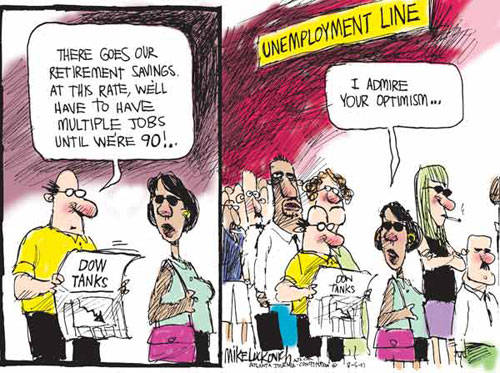
The Dow tanks. (SurlyTrader)
Brokers With Their Hands On Their Faces Blog. (Tumblr)
Smurfs are no longer welcome on Wall Street. (Reformed Broker)

From Abstruse Goose:


How to Trade Without Picking Stocks

.

There are very few stock pickers who beat automated trading strategies.

Even if you're really good, picking stocks takes work, so you'll be under-diversified, owning only a few names. With automated trading strategies, the computer does the work for you. This makes it easy to diversify. Unfortunately, some people want the volatility of having only a few stocks, as if large price movements could only exist when the market goes up.

Why Volatility Matters

Let's say that the S&P 500 returned 9% during the period you were picking stocks, and you got a return of 11%. It may look like you beat the market, but if the volatility of your portfolio was double that of the market, the market actually beat you.

Think about that for a minute. Why would someone hire you to pick stocks when he could just leverage 2:1 into the S&P 500 and get a higher return than you with the same volatility? If no one in his right mind would hire you to manage money, why do you hire yourself?

The Evidence

This article at Empirical Finance compares a stock-picker's value fund with two automated strategies. Here are some excerpts:

There ARE definitely some good stock pickers out in the market, but on average, it seems that “good stock pickers” are few and far between when you really analyze their performance over good AND bad cycles. Or as Buffett says, “There are a lot of people swimming naked [when things go wrong].” As a benchmark to assess true “value-add,” I personally like to look at how a manager stacks up against very plain-vanilla (and tradeable) quantitative value models.

First, let’s break down the the theoretical cost and benefits of a stock-picker versus a computer stock-picker (“quant-picker”):
  • Stock-picker Benefit: a concentrated portfolio of names where the manager has high conviction and potentially high alpha.
  • Stock-picker Cost: The downside of this stock-picker is limited diversification.
  • Quant-picker Benefit: Decent alpha and diversification.
  • Quant-picker Cost:  A “shotgun” research approach versus the very precise “sniper” fire research done by stock-pickers.
In the end, theorizing about whether a stock-picker (“they overcome diversification because they are so good at picking stocks”) is better or a quant-picker (“they overcome mediocre alpha by keeping costs low and being systematic”) is better, makes for a great cocktail discussion, but to get the actual answer, we can simply look at data....

While it is true that the Value Trust beat the SP 500 for 15 straight years, it didn’t really add much in terms of CAGR relative to very plain vanilla quantitative value strategies that also did exceptionally well...

Conclusion: ~tie between stock-pickers and quant-pickers during a good market....

Next, let’s look at what happens when the tide goes out to sea in 2008.

When things go bust, the quant-pickers get rocked and the stock-pickers get rocked–all beta gets rocked! However, the stock-pickers are back to SP 500 levels, whereas, quant-pickers are still way above the market. Also, following the tide washing out to sea, when the surf came back in (2009-2010), the quant-pickers carried on with their winning ways against the stock-pickers.

Conclusion: UGLY. Quant-pickers beat stock-pickers on near every dimension I can imagine.
The entire article, including charts and graphs, is worth reading here.

If you haven't thought about using trading strategies before, read this.